Advanced Satellite Technologies
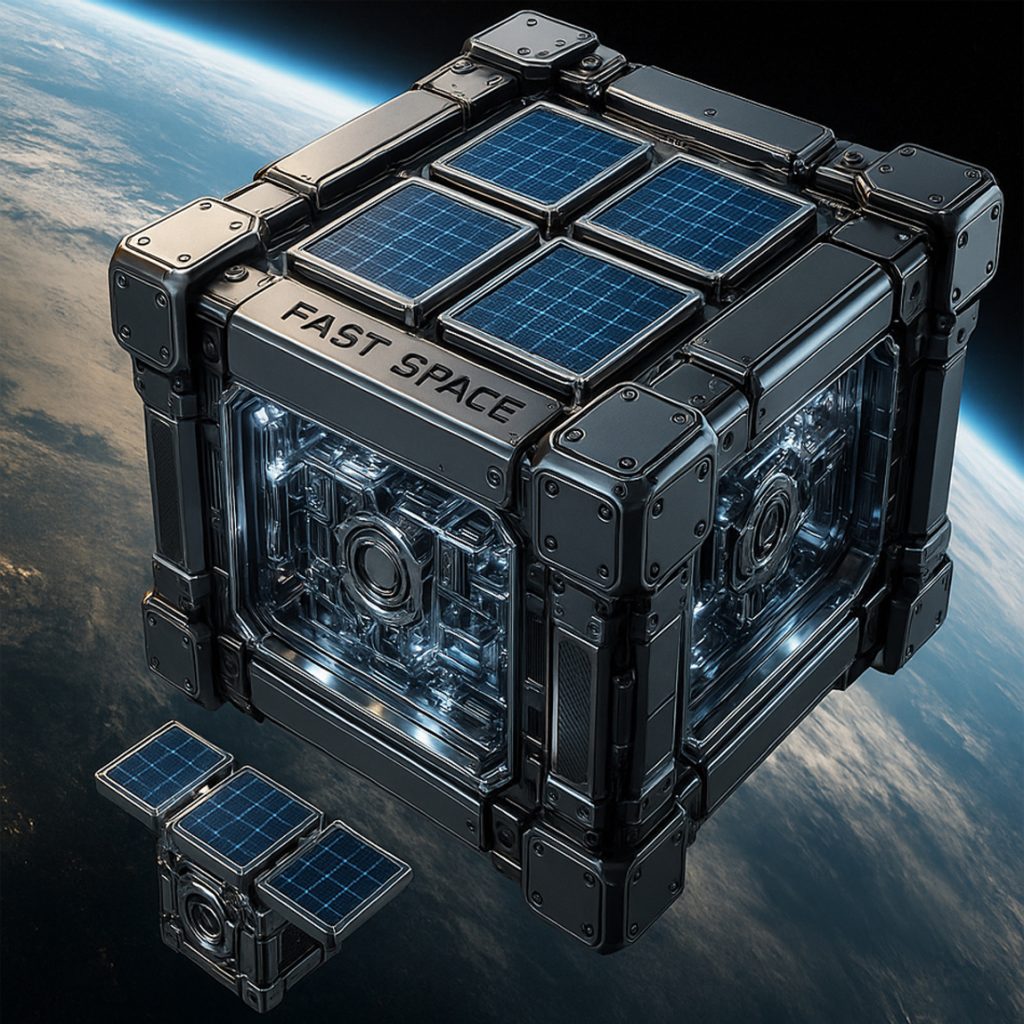
FAST SPACE’s next-generation satellite system blends revolutionary materials, structural engineering, and autonomous control with unmatched resilience and orbital utility. Designed to exceed current industry standards, it redefines space-based capability with innovation built into every element—from its chassis alloys to the deployed solar arrays.
Satellite BUS – Main Chassis (Alloy Section)
The alloy used in the satellite’s structural frame is a proprietary blend of Boron Nitride (BN) with Tantalum Hafnium Carbide (Ta4HfC5), engineered for ultra-high temperature resilience, structural integrity, and thermal conductivity. Ta4HfC5 contributes diamond-like hardness, an exceptional melting point of over 4000°C, and strong corrosion resistance. Boron Nitride adds superior thermal shock resistance, electrical insulation, and chemical inertness. The result is a material composite capable of withstanding the extreme mechanical and thermal stresses of orbital operations—far exceeding conventional satellite alloys.
Satellite BUS – Main Chassis (Glass Sections)
The transparent aluminum alloy panels integrated into the chassis serve both structural and functional roles. Designed for orbital visibility and internal sensor exposure, these panels allow for camera systems to operate from within the satellite, eliminating external lens housings and dramatically improving survivability against debris impact, solar radiation, and thermal shock.
Power Management & Thermal Regulation
FAST SPACE satellites utilize a dual-energy strategy: hydrogen-assisted generators for primary load and advanced graphene supercapacitor arrays for power storage. These supercapacitors allow near-instantaneous power delivery with long lifecycle endurance. Waste heat from operations is converted to electricity using embedded thermoelectric systems. Excess heat is vented via graphene-coated nanofluidic radiator fins—ensuring continuous operation in the harshest thermal conditions.
Communication & Navigation Systems
Each satellite includes a high-bandwidth optical laser communication module for long-distance data transmission, with RF fallback systems for low-orbit and emergency communication. Integrated deep-space telemetry, orbital navigation, and encrypted communication protocols ensure full mission awareness across multiple orbital planes.
Attitude Control & AI Autonomy
A gyro-based attitude control system ensures pinpoint stabilization in all three axes. Onboard AI runs predictive pathing and autonomous rebalancing, allowing the satellite to adjust to orbital drift, micro-impacts, or component failure without mission interruption.
Propulsion
FAST SPACE’s satellites are equipped with a scaled-down version of our proprietary hybrid drive technology—offering high thrust, ultra-high efficiency, and long orbital lifetime. The system uses a fusion of electric and chemical propulsion, providing maneuverability that surpasses conventional cold-gas or ion drives. Due to its groundbreaking nature, detailed specs remain classified.
Solar Power & Energy Generation
The satellite features four compact perovskite solar arrays embedded into its upper chassis. These aren’t standard fixed panels—instead, each quadrant houses a folded, stacked, electrically actuated array that unfolds post-launch. These self-healing, radiation-hardened panels deliver unparalleled power density while remaining operational across extreme light conditions.
Satellite Mission Intelligence & AI Integration
To ensure mission success across Low Earth Orbit, Deep Space, and planetary deployments, FAST Space will integrate advanced operational intelligence solutions from a.i. solutions, Inc.
With a proven track record supporting over 200 missions for NASA, the US Space Force, and major commercial operators, a.i. solutions provides precision, control, and security throughout every phase of satellite operation — from launch to end-of-life orbital disposal.
Their flagship FreeFlyer® software and related capabilities will be employed within FAST Space’s satellite ecosystem to provide:
- High-fidelity trajectory modeling and maneuver planning.
- Orbital coverage analysis and predictive collision avoidance.
- Automated mission operations and anomaly detection.
- Secure ground-station and satellite integration.
- Advanced astrodynamics and navigation algorithms for interplanetary pathing.
By combining FAST Space’s next-generation satellite architecture with a.i. solutions’ unmatched command, control, and AI-augmented autonomy tools, our spacecraft gain a critical edge in speed, resilience, and intelligent responsiveness in space.
This alliance ensures that FAST Space satellites don’t just function — they adapt, evolve, and lead.